Cosmic Horror Beyond Lovecraft: The Universe Has Other Ways to Frighten Us
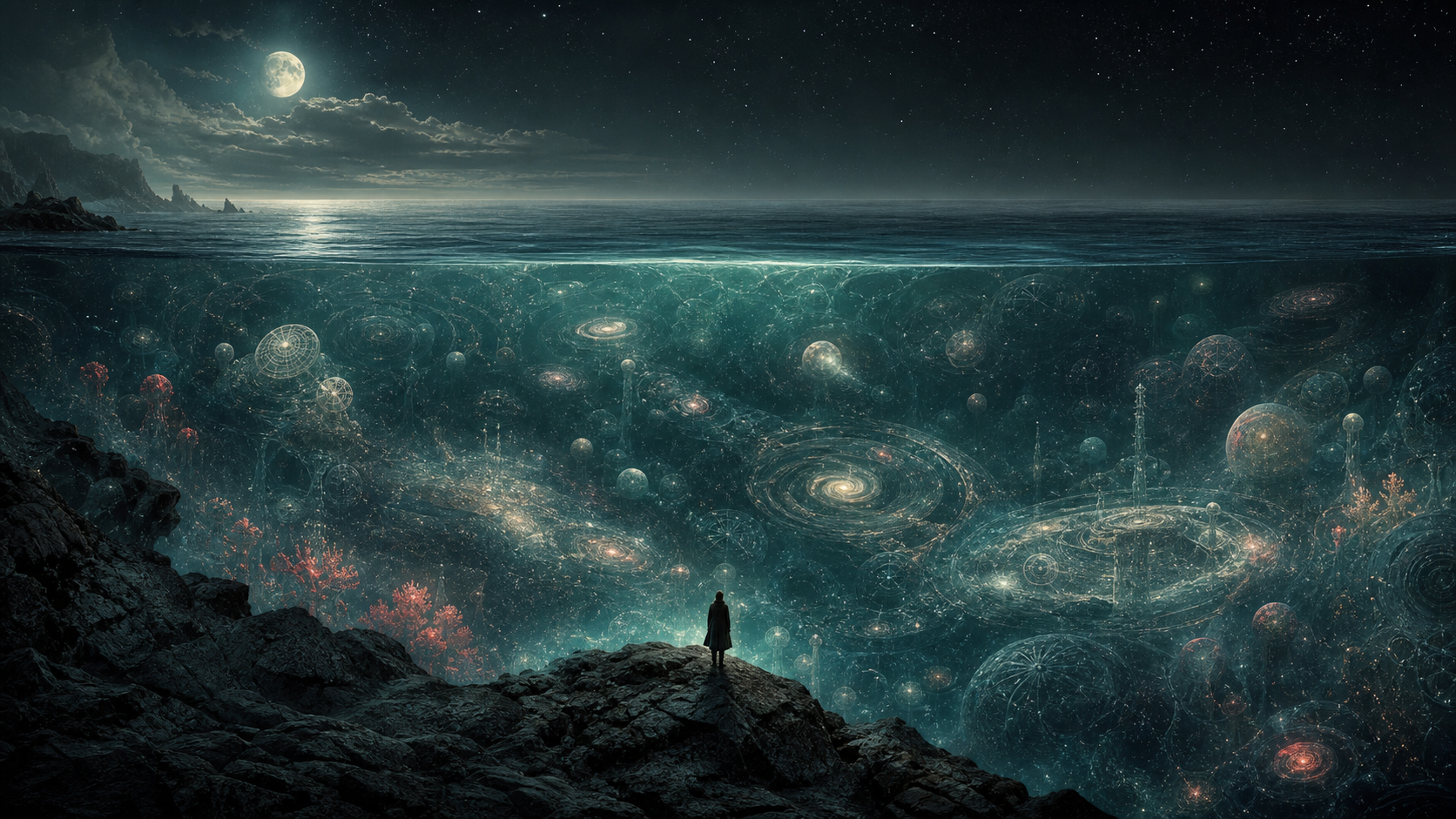
Cosmic horror is not a synonym for tentacles. Nor is every supernatural story featuring an ancient creature, a ritual, or a starry sky an example of the genre. Cosmic horror acquires its peculiar shape when fear changes scale: the threat is no longer merely a monster that can kill us, but a reality that makes our certainties about humanity, nature, and meaning seem small — perhaps irrelevant.
H. P. Lovecraft holds an unavoidable historical position in this tradition, but turning him into its boundary shrinks the map. Before, around, and long after him, other writers and media imagined bottomless oceans, indifferent ecosystems, impossible intelligences, and encounters that dismantle the observer. This curation offers seven routes. They are not “works like Lovecraft,” but different answers to the same vertigo: what happens when the universe cannot fit inside human categories?
A working definition: scale, the unknowable, and collapsed meaning
In conventional supernatural horror, the threat often confirms a moral world: there is a demon, curse, or ghost, and discovering its rules may allow resistance, escape, or repair. In cosmic horror, discovery is part of the danger. Knowledge does not necessarily organize chaos. Sometimes it reveals that order was only a human frame.
Three signs help identify this tradition. The first is scale — spatial, temporal, or conceptual — against which the individual loses centrality. The second is the resistant unknown, something that does not become an ordinary problem merely because it has been named. The third is the collapse of meaning, when identity, causality, language, or reality no longer operate as before. A work need not feature all three equally, but it must do more than replace a vampire with a many-legged creature.
1. Algernon Blackwood — The Willows
First published in 1907, The Willows turns a canoe journey down the Danube into an experience of absolute exposure. The landscape is not merely a stage for a creature; it seems to acquire a geometry and intention beyond the travelers. Wind, water, and vegetation erode the distinction between environment and presence.
It is an excellent starting point because it creates cosmic horror without relying on an explained mythology. Blackwood works through perception, isolation, and the suspicion that our world touches another mode of existence. Fear comes less from what appears than from our inability to decide where nature ends and the impossible begins.
2. William Hope Hodgson — The House on the Borderland
In this 1908 novel, an isolated house becomes an observatory for invasions, abysses, and cosmic ages. Hodgson begins with an almost Gothic structure, then pushes the narrative toward spans of time that crush domestic drama. The house is both shelter and unstable border.
Its power lies in that change of scale. The horror moves beyond “what is outside?” and asks how much of a self can remain when cosmic time passes through one life. It is an important bridge between the Gothic and modern cosmic imagination.
3. Octavia E. Butler — Lilith’s Brood
The trilogy beginning with Dawn is not usually marketed simply as horror, and that friction is precisely what makes it valuable here. After nuclear catastrophe, Lilith Iyapo awakens under the control of the Oankali, beings who survive by conducting genetic “trades” with other species. They offer humanity continuity, but on terms that destabilize consent, autonomy, and even the meaning of human.
Butler shifts cosmic horror from an unreachable entity to radical biological intimacy. The unknown enters the body, reproduction, and desire. There is no comfort in restoring human purity; there is negotiation inside a profoundly unequal relationship. The scale is evolutionary, and the collapse of meaning reaches species identity itself.
4. Jeff VanderMeer — Annihilation
In Area X, nature and language appear to rewrite each other. The unnamed biologist narrating Annihilation enters an environment where duplication, contamination, and transformation make the simple border between organism and territory useless. The more she observes, the less reliable the idea of a separate observer becomes.
VanderMeer offers ecological cosmic horror: not an evil nature, but an alterity that does not recognize our classifications. The decisive question is no longer “how do we destroy it?” but “what does remaining yourself mean after contact?” For contemporary readers, it is one of the most direct gateways into the genre — short, atmospheric, and open to interpretation.
5. Junji Ito — Uzumaki
In Uzumaki, the spiral is not merely a symbol or creature: it is pattern, compulsion, architecture, and fate. The town of Kurouzu-cho is gradually captured by a form repeating through bodies, clouds, houses, and behavior. The most ordinary image acquires a totalizing logic.
The manga displays a power specific to comics: making the escalation of the impossible visible without domesticating it. Body horror matters, but the cosmic blow comes from the idea that an impersonal form can reorganize all reality. No malicious psychology sits behind the spiral, only recurrence — and that is more disturbing.
6. The Endless, by Justin Benson and Aaron Moorhead
Two brothers return to the group they escaped and find a place subjected to time loops of different lengths. The film works with limited means and great precision: tapes, photographs, and small phenomena suggest an intelligence watching people trapped in repetitions.
Here cosmic scale appears through contrast. We see intimate dramas — guilt, belonging, dependency — inside an indifferent temporal structure. The entity does not need to fill the screen; its presence lies in the design of the cages. The Endless is a strong choice for viewers who prefer horror of ideas to spectacle and accept that part of the experience will remain unexplained.
7. Signalis
Rose-engine’s game combines retro science fiction, survival horror, and a fragmented narrative about memory, promises, and identity. The replika Elster’s search passes through ruined facilities, recurring dreams, and contradictory versions of reality. Literary and artistic references enter as echoes, not an answer key.
Its cosmic dimension lies in the erosion of stable interpretation. Playing means repeating, reconstructing documents, and doubting the protagonist’s own continuity. Yet a deeply human core remains: a promise that persists even as bodies and worlds fail. It is a perfect bridge toward a future discussion of how games turn insignificance and forbidden knowledge into mechanics.
Where should you begin?
For a short atmospheric tale, start with The Willows. For a contemporary novel, choose Annihilation. For visual impact, try Uzumaki. Then let the map expand: Butler brings vertigo into bodies and politics; Hodgson into time; The Endless into cycles; Signalis into memory and interaction.
The point is not to erase Lovecraft from history. It is to reject the idea that an entire tradition belongs to one voice. Cosmic horror remains alive precisely because it can move its centers: from abyss to forest, sky to flesh, book to screen, creature to pattern. The universe has other ways to frighten us — and every new route changes who we thought we were.
Which work expanded your idea of cosmic horror? Share your recommendation: the strongest responses may shape the next Arquivo Cósmico curation.
Two reads that speak directly to this vertigo 👇