Quake at 30: Shadow, Speed, and the Internet Inside the FPS
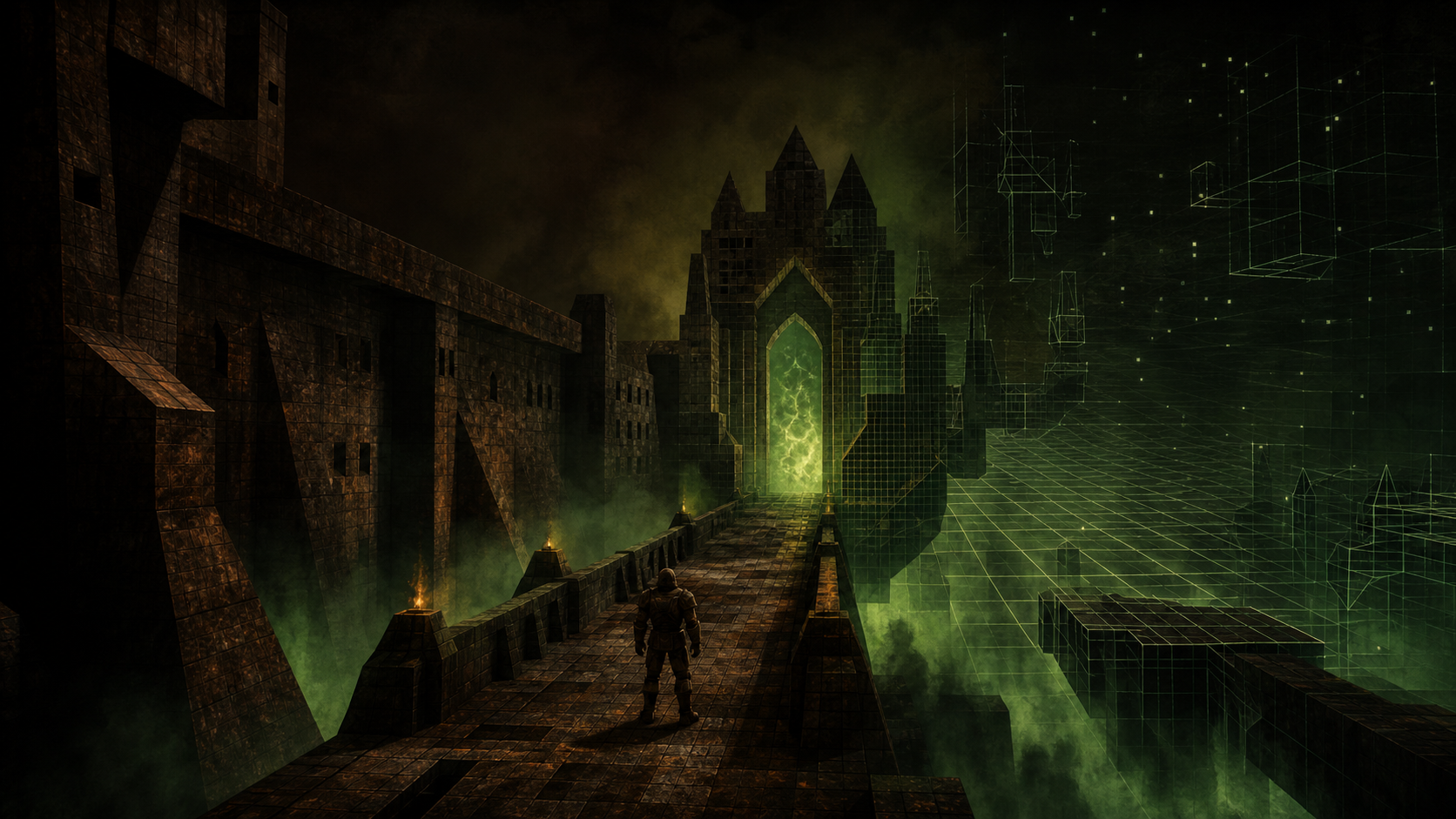
On June 22, 1996, id Software uploaded the shareware release of Quake to the internet. Thirty years later, that date marks more than the anniversary of an influential game. It marks a moment when several ideas we now take for granted — fully three-dimensional worlds, server-based matches, communities that transform games, and virtual spaces used as film sets — began to work as one cultural machine.
Quake did not single-handedly invent every one of those ideas. Its importance lies in the combination. Technology, atmosphere, and networking stopped being separate layers: the engine created spaces, those spaces created a new form of movement, and that movement met other people online. The result was not merely a more advanced first-person shooter. It was a sketch of the digital world we would come to inhabit.
When the world stopped being a trick
Doom had already produced an extraordinary illusion of depth, but its architecture still relied on what later became known as “2.5D” constraints. Quake took a different step: environments and characters were made from polygonal geometry rendered in real time. Players could look up and down, cross rooms stacked above one another, and understand the level as a continuous volume.
That changed more than appearance. Stairs, bridges, drops, and projectiles acquired a different physical presence. A map was no longer just a maze seen through someone’s eyes; it was an arena that demanded vertical reading. Quake’s speed emerged from that relationship between body and architecture. Jumping, cutting corners, controlling height, and preserving momentum became part of a grammar players would expand far beyond the manual.
The engine also became a school. QuakeC separated much of the game logic from the engine core and made community experiments more approachable. When the engine source was released under the GPL in 1999, that life continued through ports, tools, and derivative projects. Quake’s influence is found not only in games that licensed its technology, but also in the number of people who learned to build worlds by opening it up.
The sound of a place that should not exist
The memory of Quake is often brown, metallic, and damp. Castles, industrial corridors, and occult symbols seem to belong to incompatible periods. That collage could have become visual noise. The sound work by Trent Reznor and his Nine Inch Nails collaborators gave the nightmare a single nervous system.
Rather than treating the score as a constant run of action music, Quake uses drones, noise, reverberation, and long stretches of emptiness. Sound does not simply accompany the environment; it makes the environment feel contaminated. Machines breathe, doors groan, and something seems to move beyond the field of view. Aggression is present, but waiting is what creates fear.
This helps explain why Quake remains recognizable even when its monsters and weapons are removed. Its signature lives in the pause between rooms, in the echo that implies a scale larger than the screen, and in the sense that technology has opened a door to something ancient. The 3D convinces the eyes; the sound convinces the body.
Deathmatch as an internet ritual
Quake arrived as the commercial internet was entering homes. Playing online meant dealing with dial-up connections, latency, server addresses, and small bodies of knowledge passed among friends. The original multiplayer worked, but domestic connections exposed its limits. In December 1996, id released QuakeWorld, an internet-focused version with networking changes — including client-side prediction — that made response more manageable over slow modems.
That technical answer helped establish a social practice. Servers developed regulars, nicknames carried reputations, and deathmatch became an appointment. The arena had simple rules, but the culture surrounding it was complex: learning routes, reading opponents, debating configurations, exchanging demos, and returning the following night.
The meaning of speed itself was rebuilt collectively. Emerging movement techniques turned accidents and quirks of physics into skill. What the code allowed, players transformed into style. We now recognize that dynamic in competitive games, speedrunning, and communities that treat systems as material for interpretation.
Mods, cameras, and participatory culture
When a game offers tools, malleable code, and a connected community, it stops being only a finished work. Quake became a platform for maps, conversions, and experiments that pointed toward entire genres. The original Team Fortress mod, for instance, helped establish class-based multiplayer shooting.
Watching also took on a new meaning. Engine-recorded demos could preserve matches and stage scenes. In 1996, the Rangers clan’s Diary of a Camper used Quake as the set for a short story filmed inside the game. The word “machinima” came later, but the core idea was already present: real-time environments could become sets, avatars could become actors, and players could operate like a film crew.
This may be Quake’s most contemporary legacy. Mods, gameplay videos, livestreams, private servers, and creation inside platforms belong to the same shift: audiences do not merely receive. They inhabit, modify, record, and redistribute.
Thirty years inside the same idea
Quake has aged in a curious way. Its polygons clearly belong to 1996, yet its social logic feels current. An extensible engine, a community that learns collectively, server-organized matches, identities built through nicknames, and virtual images turned into stories: all of this became everyday infrastructure for digital culture.
Celebrating its thirtieth anniversary does not require claiming that it did everything first. It is enough to recognize how few works connected so many changes at the same moment. Quake demonstrated that 3D could have weight, that sound could turn technology into atmosphere, and that an online arena could become a social place.
Today, we open a game expecting to find a world, a community, and tools for building something around it. In 1996, Quake made that combination feel like a newly opened door. The echo from the other side has never stopped.
Continue exploring
Books about video game history, retro-inspired peripherals, and retrogaming hardware can help reconstruct the context of that turning point. Affiliate suggestions are placed in the first comment at no additional cost to readers.
Editorial date note: this feature uses June 22, 1996, the date the public shareware build was uploaded to internet archives. Some commercial timelines use later dates for physical retail availability, so the article names the event being commemorated.
To help rebuild the context of that turning point 👇