Cosmic horror in video games: when winning solves nothing
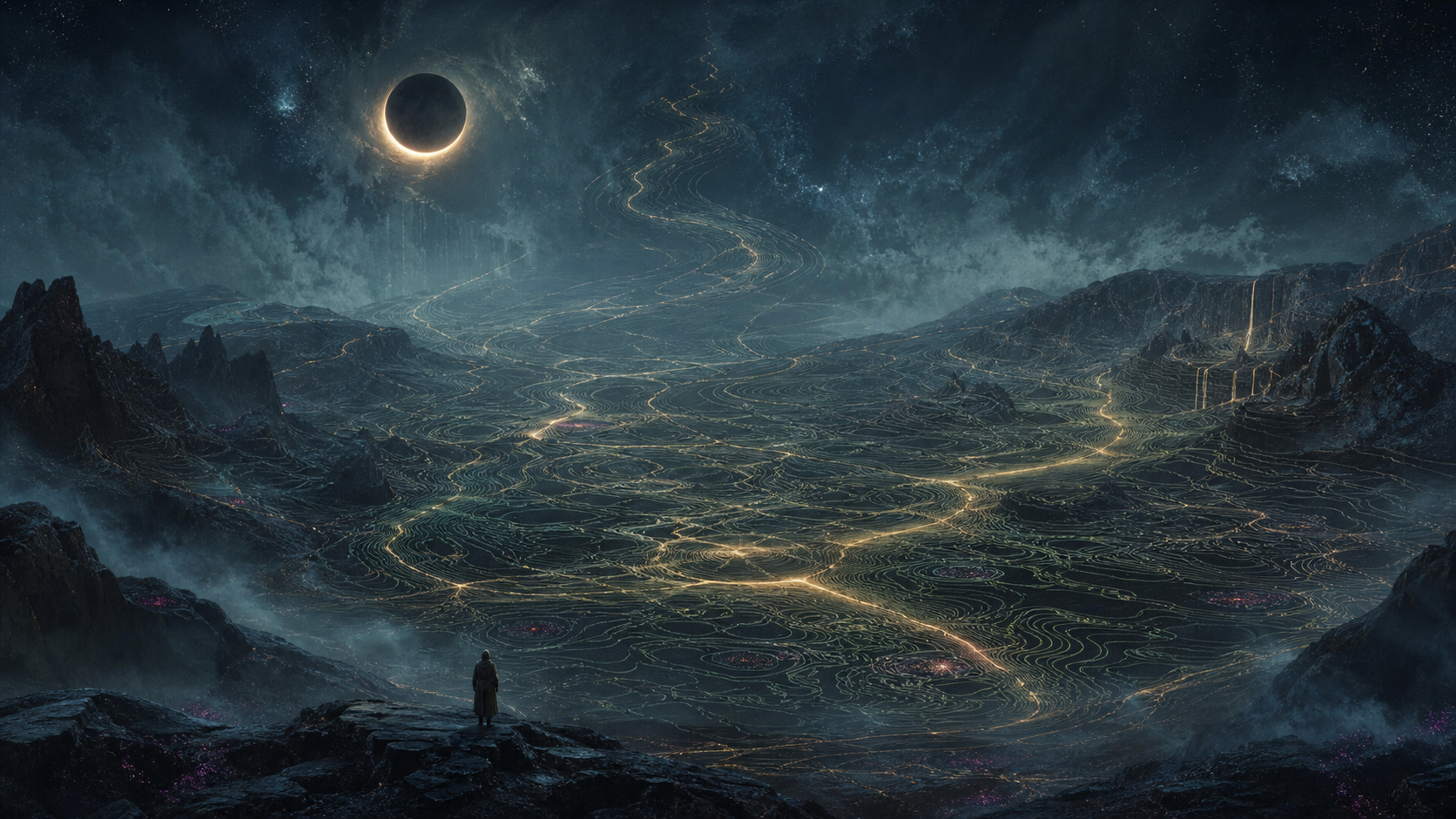
In many games, victory puts the world back in order. The map becomes safe, the enemy disappears, the music changes, and the screen confirms that our actions mattered. Cosmic horror becomes especially interesting when that promise fails.
You may survive, defeat a creature, reconstruct the timeline, or reach the credits. The universe still refuses to fit the categories you brought into it. Mechanical victory exists, but it cannot restore a human scale, erase what was discovered, or guarantee that understanding and control are the same thing.
Games give the genre something literature and film cannot provide in quite the same way: systems. The unknown need not exist only as an image or revelation. It can inhabit navigation, repetition, resource economies, interfaces, and even the thing a game calls progress.
Cosmic horror, in this list, does not mean “a monster with tentacles.” It means experiencing a world that resists our scale, encountering an unknown that cannot be reduced to a convenient explanation, and realizing that accomplishment may restore no meaning at all.
The discussion contains light spoilers about premises and structures, but avoids revealing endings.
1. Darkwood: the map is not shelter
Exploration in Darkwood does not equal domestication. The forest shifts, landmarks offer limited reassurance, and returning to a hideout does not end the danger. It merely begins another form of tension.
A map usually promises mastery: as blank spaces fill, territory becomes information. Here, that relationship remains unstable. Knowing where something stood does not make the path reliable; recognizing a region does not mean you belong there. Every daytime detour consumes precious time. At night, walls, furniture, and light improvise a fragile border between the player and whatever moves outside.
The horror grows from two opposing needs: explore to acquire resources, then retreat to survive. The forest is not scenery between encounters. It is a system that imposes rhythm, disorientation, and doubt. “Winning” one night means reaching the next morning knowing the cycle will begin again.
2. Sunless Sea: the ocean measures your ambition
Sunless Sea turns travel into an equation that never feels comfortably solved. Fuel, supplies, crew, terror, and distance make every route a wager. The underground sea is not empty space between ports; it is the presence organizing every decision.
A captain can gather stories, improve the ship, and learn routes. Knowledge still does not shrink the ocean. It only makes negotiation with its scale possible for a little longer. Progress expands your options, then tempts you toward journeys that are larger, more expensive, and stranger.
This economy creates cosmic horror without relying on a jump scare. The player studies the map, plots a seemingly viable line, and learns too late that precise numbers do not make the world reasonable. Personal ambition feels enormous in port and very small after the lights disappear behind you.
3. Outer Wilds and Echoes of the Eye: knowledge is the only progression—and the burden
In Outer Wilds, the character does not accumulate power; the player learns. Routes, phenomena, and relationships that once seemed incomprehensible gradually form a mental model of the solar system. Nearly everything needed to advance could be done from the beginning—if you knew how.
That structure makes knowledge a remarkable tool, but not a fantasy of control. Understanding why something happens does not mean you can prevent it. Curiosity opens doors while removing comfortable versions of reality. Echoes of the Eye deepens the tension by connecting discovery, fear, and the desire to conceal a truth.
The loop is more than repeated trial and error. It changes the meaning of familiar places. A planet that looked like an obstacle becomes a document; a ruin becomes a decision; a lost minute gains cosmological value. Victory, if the word applies, means acting lucidly within a scale that will not bend to the protagonist.
4. Returnal: repetition does not repair the experience
Roguelikes often turn repetition into improvement: we fail, learn, and become more efficient. Returnal uses that vocabulary while corrupting its promise. Each cycle also unsettles memory, identity, cause, and effect.
Mastering combat does not answer the central question. The more capable the player becomes, the deeper they travel into an experience whose interpretation remains unstable. Mechanical and narrative progress move together without producing a neat, restorative answer.
That friction matters. The game rewards precision, pattern recognition, and persistence—the exact virtues that normally guarantee mastery. Yet the ability to cross a world is not the ability to explain it. A cycle can be defeated as a challenge and remain open as a wound.
5. Signalis: limited inventory, unbounded memory
Signalis uses narrow corridors, scarce resources, and an inventory that forces you to leave things behind. The limit resembles a classic survival-horror rule, but it also creates an idea: you cannot carry everything.
Documents, images, repetition, and fragmented identities make the experience shift among memory, transmission, and dream. The player organizes clues while the game questions the stability of the person remembering and the person being remembered.
Resource management is not separate from the theme. Choosing ammunition, a key, or a tool materializes incomplete perception. The interface does not reveal neutral truth; it defines how much of the world can travel with you. Moving forward requires abandoning objects—and perhaps interpretations—without knowing whether you left the right thing behind.
6. Dredge: routine makes the impossible manageable
Dredge begins with recognizable work: sail, fish, sell, improve the boat. The loop is clear and almost comforting. Then night alters distances, shapes, and judgment.
The cosmic effect comes from contrast. The same inventory grid that organizes fish tries to accommodate things that should not fit a commercial routine. Upgrades let you travel farther, but distance and speed do not remove vulnerability. They expand curiosity’s reach.
The map offers objectives, the market assigns prices, and the journal records tasks. These are human instruments trying to frame a sea that rejects the frame. The player learns to manage the impossible, but management is not resolution. Returning to port with a profit may be a perfect victory for the economy and a complete defeat for any sense of normality.
7. Bloodborne: seeing more does not make you safer
In Bloodborne, the most disturbing transformation is not merely becoming stronger. It is perceiving more. Changes in the world recontextualize places that seemed familiar and suggest that reality already contained layers for which the observer lacked the necessary eyes.
This reverses a common rule of games: information should reduce danger. Here, better vision can make the world less habitable. Learning does not illuminate a dark room so everything returns to its place. It reveals that the room was never what we imagined.
Bosses can still be defeated, shortcuts opened, and patterns mastered. Mechanical excellence is real. The hunt, however, cannot return innocence to the hunter. Once the scale changes, the old setting survives only as an inadequate reading.
What do these games accomplish that a creature alone could not?
They spread horror across four layers.
The map stops being property
Instead of confirming conquered territory, it records distance, risk, and absence. It may change, hide relationships, or expose a space larger than your reserves.
Progression demands something else
Becoming stronger, faster, or better informed opens paths while drawing the player closer to whatever dismantles certainty. Skill increases; comfort declines.
Repetition changes the observer
Loops, returns, and routines do not restore an earlier state. Every passage adds context. The place looks the same; the person reading it no longer is.
The ending closes actions, not the universe
Credits are a production boundary, not necessarily a narrative cure. The best cosmic horror lets a journey end without pretending that one journey resolved the entire world.
When winning solves nothing
None of this makes action meaningless. On the contrary, action carries more weight when restoration is not guaranteed. Saving someone, transmitting a discovery, keeping a promise, or accepting a limit can matter profoundly even if the cosmos remains indifferent.
That may be the strongest contribution games make to cosmic horror. They let us master controls within a reality we do not master. They teach our hands a system while the story erodes our certainty that every system exists to serve us.
In the end, the question is not only “what creature was waiting?” It is “what did the game make you repeat, map, spend, and learn before you understood that reaching the end would not restore the beginning?”
Which game made you feel smaller—even after you won?
To keep travelling through cosmic horror 👇