Dungeons & Dragons and Tolkien: relatives, not synonyms
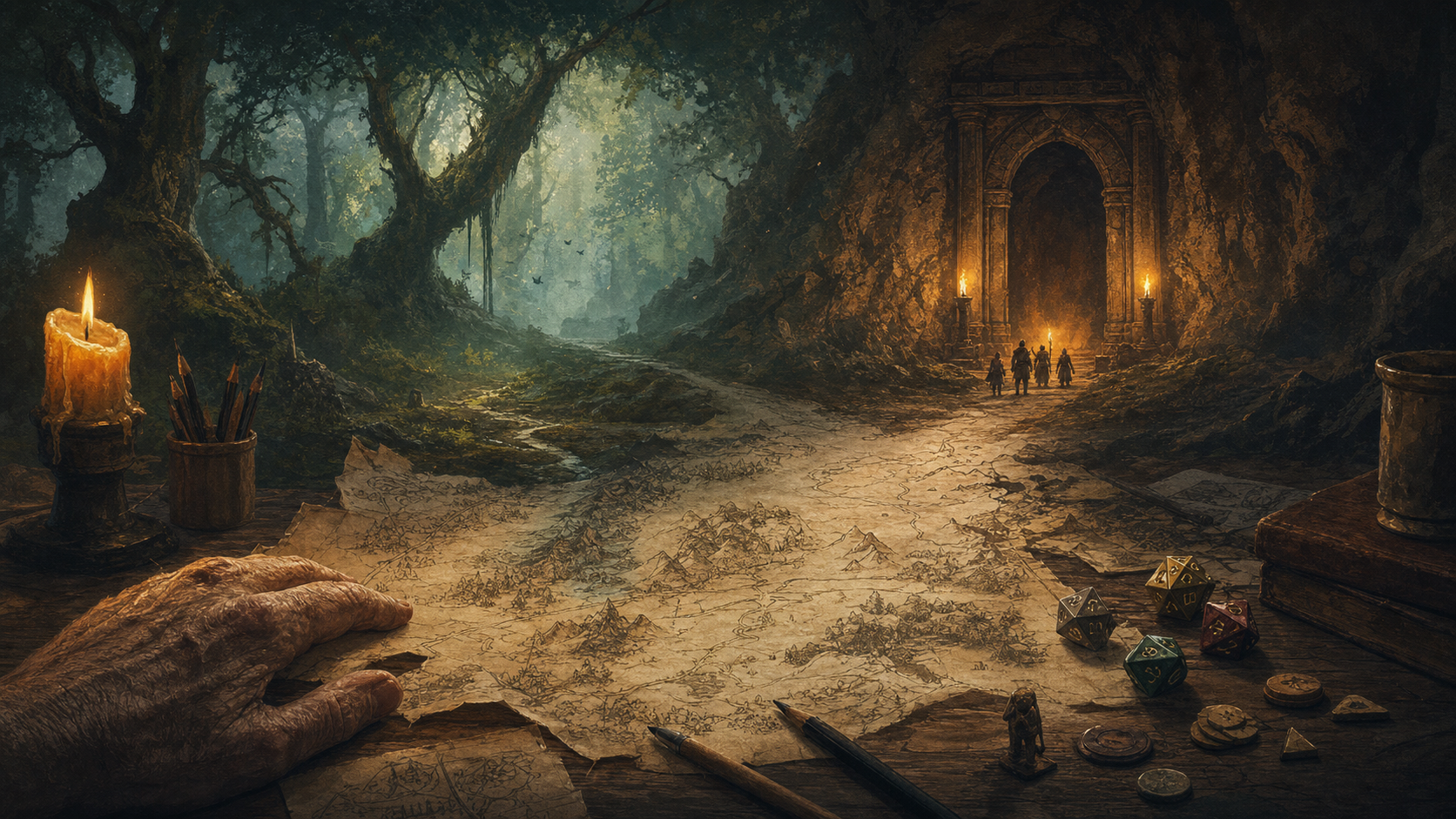
Put elves, dwarves, a fellowship, and a long road in the same sentence and the comparison seems inevitable: Dungeons & Dragons is simply Tolkien with dice. The resemblance is real and important. It helped generations recognize the vocabulary of fantasy at a glance. But using it as a complete explanation erases what made role-playing a form of its own.
D&D did not emerge from a single bookshelf. It grew where miniature wargames, campaign play, dungeon exploration, fantasy, horror, and adventure fiction met. Tolkien belongs in that family tree; he is not the whole tree.
The kinship is easy to see
A Tolkien reader opening a fantasy RPG finds familiar relatives: ancient peoples, ruins of lost ages, storied swords, maps, journeys, and tension between ordinary life and vast powers. Tolkien did not invent elves and dwarves, but his reworking of them became a dominant language of modern fantasy. Early D&D operated within that cultural horizon.
That does not make every similarity a simple causal line. Folklore, mythology, earlier fiction, and publishing history also matter. The careful claim is both smaller and stronger: Tolkien helped establish the vocabulary through which millions imagined fantasy, and D&D made that vocabulary playable.
In literature, a fantastic people can embody centuries of language, memory, and loss. At the table, it must also become a choice: what can this character do, how do they relate to the party, and what possibilities do they create during play? Moving from novel to game is not copying. It is transformation.
Before the tavern came the wargaming table
D&D’s mechanical genealogy runs through Chainmail, the miniature-warfare rules published by Gary Gygax and Jeff Perren in 1971. Its fantasy supplement brought heroes, magic, and creatures into battles that still belonged to the wargaming tradition.
Dave Arneson pushed campaign play to another scale. Instead of controlling armies alone, participants followed individual characters, explored environments, carried consequences across sessions, and acted under open-ended refereeing. Gary Gygax developed and organized those experiments with Arneson in the game published in 1974.
That origin explains things Tolkien alone cannot: measurements, probabilities, equipment, survival, tactical combat, and a referee administering an open world. The central question is no longer only “what does this journey mean?” It also becomes “what do you do now?”
The dungeon changes the story
The early RPG dungeon is more than a Gothic setting. It is a decision engine. Every door distributes information and risk; light and time become resources; moving forward promises discovery and treasure; returning alive makes another attempt possible.
This structure brings the game close to pulp and sword-and-sorcery stories, where adventurers enter dangerous cities, forgotten tombs, and strange territories. Robert E. Howard, Fritz Leiber, and many others belong to this neighborhood. The celebrated “Appendix N” reading list in the 1979 Dungeon Masters Guide includes Tolkien, but it presents a much broader library. Its most immediate influences include L. Sprague de Camp and Fletcher Pratt, Howard, Leiber, Jack Vance, H. P. Lovecraft, and A. Merritt.
Vance is especially useful for understanding classic game magic. Spells prepared, cast, and then forgotten do not need Tolkien as their source. So-called “Vancian magic” shows how one rule can carry another literary tradition into the same world of elves and dwarves.
The novel seeks renunciation; the table also welcomes treasure
In The Lord of the Rings, power and possession are moral problems. Victory depends on destroying what nearly everyone might wish to wield. The journey imposes loss, while heroism often appears as endurance, mercy, and renunciation.
A D&D campaign can tell exactly that kind of story. Its classic structure, however, also rewards curiosity, risk, and acquisition. Characters open the forbidden door, retrieve objects, gain experience, and return more capable. Where a novel organizes a closed arc, a campaign must keep generating choices week after week.
An adventuring party is therefore not automatically a Fellowship. A literary company serves a mission whose shape and ending have been composed by an author. Players may abandon the plan, bargain with the enemy, turn a minor character into the protagonist, or decide that the tower on the map looks more interesting than the main quest.
From authored work to negotiated world
Tolkien built a mythology of extraordinary density, full of languages, genealogies, and conflicting versions of the past. A role-playing table builds differently. The facilitator prepares situations; players introduce intentions; rules and dice create consequences no one fully controls.
This changes authorship. A setting may be as detailed as Middle-earth, but it becomes a game only when it can be interrupted. A player’s question may establish a custom absent from the notes. A failed roll may burn down a city meant to be a stopover. A random encounter may reorganize the campaign.
Here D&D stops being “imitated fantasy” and becomes a fantasy laboratory. It gathers images from literature, mythology, cinema, pulp, and wargames, then submits them to collective improvisation.
Influence is not identity
Acknowledging Tolkien does not require turning every resemblance into his exclusive legacy. Acknowledging pulp does not require denying Tolkien’s impact. Recognizing wargames does not diminish the literary imagination of role-playing.
The history becomes clearer when we keep its layers:
- Tolkien helped establish a modern vocabulary of peoples, ages, and fantastic journeys;
- wargames supplied procedures, refereeing, and campaign structures;
- dungeon exploration turned space into risk, resource, and choice;
- sword and sorcery brought morally ambiguous adventurers, dangerous cities, and fortune-seeking;
- writers such as Jack Vance left visible traces in particular mechanics;
- the table transformed all of it through shared decisions and open-ended continuity.
Relatives, then. Not synonyms.
What to bring to your next table
If you love Tolkien, bring more than elves and maps: bring the burden of memory, the temptation of power, the beauty of vanishing things, and the value of mercy. If you love exploratory D&D, preserve uncertainty: genuinely branching paths, resources that matter, and rewards that carry a price.
If this will be your first adventure, begin with our guide to a first session. You do not need to choose a single tradition before rolling the dice. You only need to know that every imaginative choice changes the kind of story your table can tell.
At your fantasy table, what matters most: the journey, exploration, risk, or the shared world?
Sources and further reading
- Gary Gygax and Jeff Perren, Chainmail (1971), and Gary Gygax and Dave Arneson, Dungeons & Dragons (1974), primary sources for the game’s lineage.
- Gary Gygax, “Appendix N: Inspirational and Educational Reading,” in Dungeon Masters Guide (1979), p. 224.
- Gary Gygax, “The influence of J.R.R. Tolkien on the D&D and AD&D games,” Dragon no. 95 (1985): https://pied.nu/dragon/files/Drmg095.pdf
- Gygax Memorial Fund, public initiative based on Appendix N: https://www.gygaxmemorialfund.org/ggana-initiative
To bring that inheritance to your table 👇