Where is everybody? The Fermi paradox in seven answers
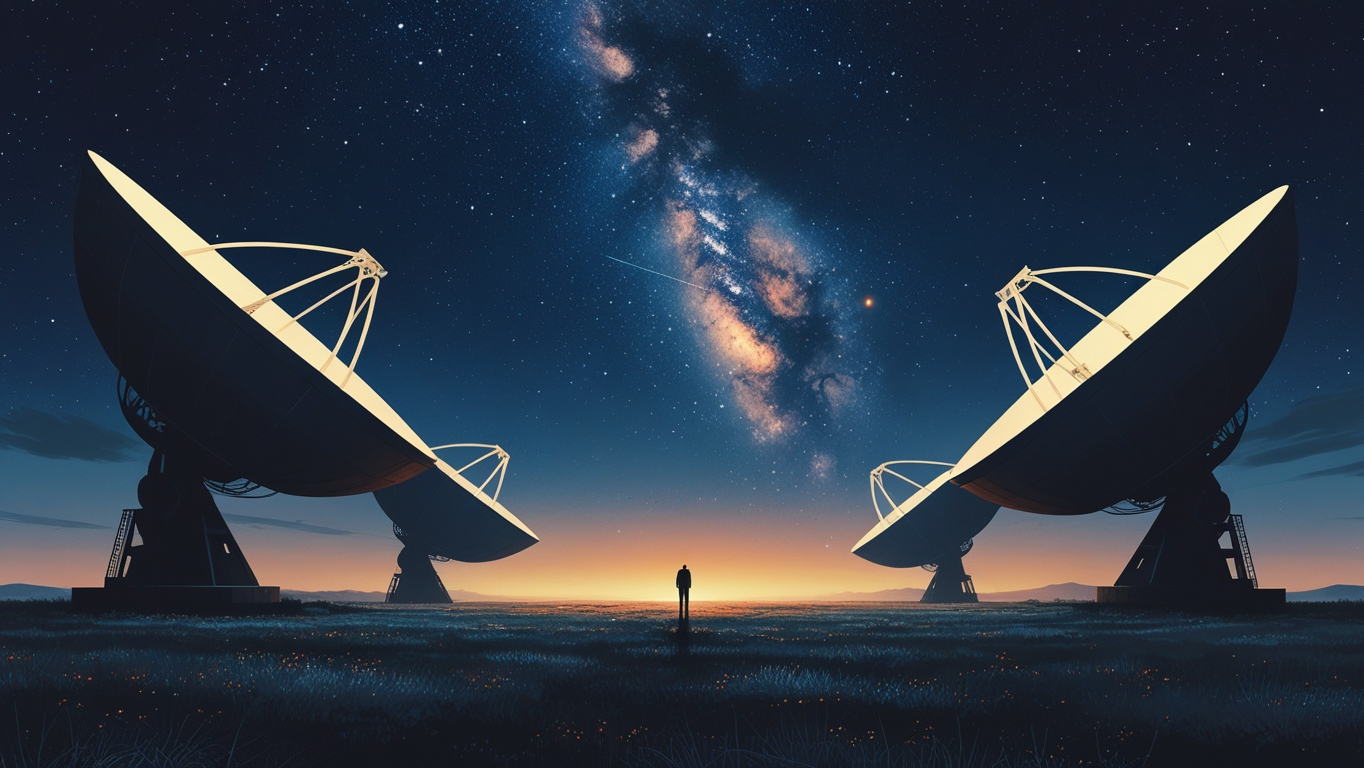
The story is almost too good to be true, and it is true anyway. Summer of 1950, Los Alamos. Enrico Fermi is having lunch with colleagues and the conversation drifts through flying saucers, interstellar travel and the possibility that the universe is crowded. Somewhere between one sentence and the next, Fermi drops the question that has refused to go away ever since:
“Where is everybody?”
It was not skepticism. It was arithmetic. The Milky Way holds more than a hundred billion stars, and many of them are billions of years older than the Sun. Even a slow civilization, travelling well below the speed of light and stopping to settle one system at a time, would cross the entire galaxy in a few million years — a blink on the cosmic scale. If intelligent life were common, someone should have arrived here already. Or at least left a note.
The sky, however, is quiet.
Eleven years later, Frank Drake would write on a blackboard the equation that carries his name: a chain of factors that, multiplied together, estimate how many communicating civilizations the galaxy should hold. The equation is honest about its own ignorance — nearly every term in it is a guess. But it crystallized the problem. On one side, a calculation that insists on returning large numbers. On the other, the silence. The distance between the two is the Fermi paradox.
What follows are not rival theories competing for a prize. They are seven ways of facing the same silence — and, as you will notice, each one is less a thesis about aliens than a thesis about us.
1. Nobody is out there: Earth is rare
The most direct answer is that Drake’s arithmetic is off by a lot, and the right number is close to one.
This is the Rare Earth argument, put forward by geologist Peter Ward and astronomer Donald Brownlee in 2000. Microbial life may well be ordinary in the universe; complex, animal, technological life would depend on an improbable stack of coincidences. A planet at the right distance from the right kind of star. A moon large enough to stabilize the axial tilt. A gas giant in the right orbit to sweep away part of the comet traffic. Plate tectonics recycling carbon for billions of years. A magnetic field. A galactic neighbourhood without supernovae going off too close.
None of these ingredients is miraculous on its own. The problem is the conjunction. Multiply enough moderate probabilities and the result shrinks to almost nothing.
It is the most economical explanation for the silence, and the most uncomfortable: it answers Fermi’s question by saying there is nobody to ask it of.
2. There is a filter — and it may be ahead of us
In 1996, economist Robin Hanson gave the problem a formulation nobody has managed to forget: the Great Filter.
Between dead matter and a civilization that colonizes stars there is a sequence of steps. Chemistry becoming metabolism. Simple cell becoming complex cell. Single-celled organism becoming multicellular. Intelligence. Technology. Expansion. One of those steps, Hanson argues, is improbable enough that almost nobody gets through it. That is the filter. And the only question that matters is whether it sits behind us or ahead.
If it is behind — if the hard jump was the origin of life itself, or the complex cell, which on Earth took billions of years to appear — then we are past it, we are extremely rare, and the silence is just loneliness.
If it is ahead, the news is terrible. It would mean civilizations arise with some regularity and then vanish, all of them, before leaving a trace. Not one exception among a hundred billion stars.
Hence the uncomfortable argument that became something close to folklore among people who think about this: finding complex life on Mars or on the moons of Jupiter would be very bad news. The easier it turns out to be to get where we are, the more likely it is that the real obstacle is still ahead.
3. We arrived too early for the party
The universe is roughly 13.8 billion years old, but low-mass stars — red dwarfs, which are the majority — will keep burning for trillions of years. In terms of time available for life to appear, the cosmos has barely started.
Maybe there is no silence at all. Maybe Earth simply got here first. Being the first civilization in a galaxy requires nothing special: somebody has to be.
There is also a less flattering version of the timing argument. A technological civilization may last a few thousand years, or a few hundred. The window in which it broadcasts radio may be shorter still — we ourselves have spent much of the last century lowering power and trading open transmission for cable, fibre and tight beams. If every civilization lights a lamp for an instant and puts it out, two lamps burning at the same time, close enough to see each other, become a statistical coincidence. The sky may be full of ghosts of signals that went dark millions of years ago.
4. They are here and we cannot recognize it
This is the answer that fiction likes best, because it moves the problem from astronomy to perception.
Our entire search assumes an advanced civilization would do recognizable things: broadcast on radio, build enormous structures around its star, send probes that look like ours. But those are the things we would do, with the technology we have, at the stage we are in. Searching for radio today may be the equivalent of searching for smoke signals.
There is an uncomfortable extension of the idea: perhaps some contact has already happened and meant nothing. An object crossing the solar system and disappearing before any decent observation — as happened in 2017 with ’Oumuamua, the first interstellar object ever detected, which passed too fast to answer the questions it raised. Or a 72-second signal picked up in 1977 and never repeated, remembered as the Wow! signal after the note the astronomer scrawled in the margin. None of that is evidence of life. But it illustrates the point: if an event does not repeat, it does not become knowledge — it becomes an anecdote.
5. Everybody chose to stay quiet
The dark forest hypothesis became famous through Liu Cixin’s novel published in 2008, but the intuition is older: if you cannot judge the intentions of whoever is out there, and if distance makes it impossible to verify anything in time, then revealing your position means accepting a risk you cannot calculate.
In that scenario the universe is a forest where everyone walks armed and silent. Speaking is the one irreversible mistake. Whoever spoke is no longer around to tell the story.
It is not a testable hypothesis — which is precisely why it works so well as fiction and so badly as science. But it reframes the silence elegantly: perhaps it is not absence. Perhaps it is policy.
Worth noting that the debate is real among researchers, under the name METI — the proposal to transmit actively instead of only listening. There is no consensus. There are respectable people on both sides, which is a good sign that nobody holds the piece of data that would settle it.
6. We are searching wrong, with little time and little money
There is a comparison that circulates among SETI researchers and works as a cold shower: if you scooped a single random glass of water out of the ocean and found no fish in it, concluding that the sea is sterile would be hasty.
Decades of searching sound like a long time, but the volume actually covered — in frequencies, in directions, in sensitivity, in hours spent listening — is minuscule next to the space of possibilities. And most of that effort was made on small budgets, on borrowed telescopes, in observing windows that almost always lost the competition to other research.
This answer has one advantage over the others: it is the only one that can be attacked with work. It requires no exotic hypothesis about the nature of life or intelligence. It requires instruments, observing time and patience.
7. The zoo, the quarantine and the glass we cannot see
In 1973, radio astronomer John Ball proposed what he called the zoo hypothesis: they know we are here, and the collective decision was not to interfere. The galaxy would hold a kind of agreement — leave young civilizations alone until they mature, or until they find out on their own.
It is the most comforting explanation and the most fragile. It demands absolute unanimity across millions of years, among cultures that would have nothing in common. One dissenter is enough to turn the zoo into contact.
But it has a merit: it exposes the structure of every other answer. We are trying to explain an absence. And absence is the kind of thing that accepts infinite explanations, all of them compatible with the data, because there is almost no data at all.
The paradox is a mirror
Notice what happened along this list.
Those who believe we are rare read the silence as confirmation that life is precious. Those who fear the Great Filter read it as a warning about our own fragility. Those who propose the dark forest project onto the cosmos the suspicion they learned from human history. Those who talk about the zoo imagine responsible adults keeping watch. Those who argue we are searching wrong bet that the problem is method, and method can be fixed.
None of these readings comes from the data, because the data does not exist. All of them come from something the person already believed about what it means to be intelligent, to be vulnerable and to be alone.
That is why the Fermi paradox has survived more than seventy years without a single new piece of evidence to feed on. It is not an astronomy problem waiting for a better telescope. It is a question about our place disguised as a technical problem — and it will keep standing as long as the sky does not answer.
In the meantime, the one thing we know for certain about intelligent life in the universe is that it exists on at least one planet. And that this planet, for now, is solely responsible for keeping the count from dropping to zero.
To keep looking up 👇