Star Trek at 60: the future that aged better than its technology
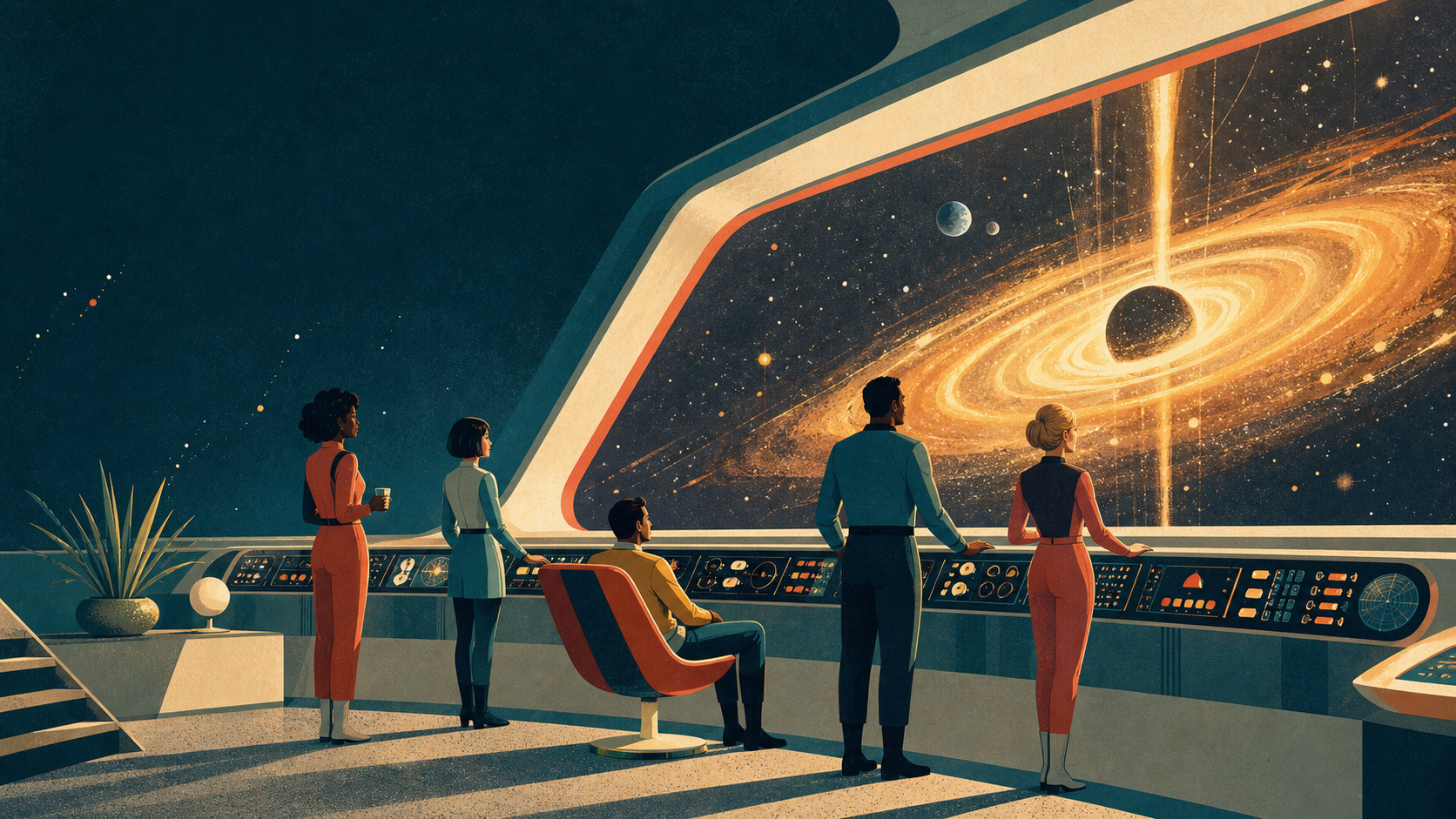
On September 8, 1966, NBC broadcast “The Man Trap” in the United States, the first episode of Star Trek to air. Sixty years later, it is easy to look at that bridge full of colored buttons, tiny screens, and visibly constructed walls and wonder how such a dated vision of the future can still feel so necessary.
The answer is not in the devices. It is in the intention.
Star Trek aged because all science fiction ages. Every future eventually reveals the period that imagined it. Its communicators look less capable than the phone in our pockets; computers speak but occupy rooms and follow rigid commands; interstellar travel coexists with controls that resemble telephone switchboards. The original series did not predict the twenty-first century. It launched the desires and contradictions of the 1960s toward the stars.
Yet a larger desire held that set together: the idea of human beings surviving their destructive impulses and choosing to explore the unknown together. That hypothesis, far more than any gadget, keeps the franchise in orbit.
The future always reveals the present
When a story imagines technology, it usually enlarges objects that already exist. Portable communicators, automatic doors, information screens, and a computer voice were immediately readable signs of the future. Some acquired real-world equivalents; others remained inside the visual language of low-budget television.
That is not a special failure of Star Trek. It is part of the genre. Fictional hardware must make sense to the audience at a glance. Even the most advanced vessel therefore carries familiar buttons, chairs, corridors, and hierarchies. The strange needs an entrance.
The cardboard scenery serves an honest purpose: it does not need to be the future; it needs to create a stage on which a conversation about the future can happen. The planet of the week may be a quarry, a garden, or a redressed room. What truly changes is the moral question placed before the crew.
An imperfect utopia—and a useful one
The utopia of Star Trek was never a coherent manual. The series carried the limitations of its era, its industry, and its creators. Not every promise of equality was fully realized on screen. Not every negotiation escaped the logic of power. Not every encounter with difference granted the other side equal freedom.
Still, its central image was radical: a diverse crew working together met the unknown with scientific instruments and a diplomatic vocabulary. An adventure could end in battle, but battle was not the only possible language. Observation, translation, argument, and retreat could also be dramatic actions.
Many visions of the future treat violence as inevitable and call that realism. Star Trek asks whether a true technological leap may depend on an ethical one: perhaps we travel farther only after learning not to turn every difference into a threat.
Believing conflict can be mediated is not naïve. Assuming that force, fear, and competition will permanently solve problems created by force, fear, and competition is.
Curiosity as an engine for adventure
At the series’ heart is a simple narrative proposition: go where no one has gone, not to conquer, but to discover. Curiosity turns science into action. Analyzing a phenomenon, understanding a culture, or establishing communication can carry the dramatic weight of a chase.
This produces a rare kind of heroism. The most important person in a scene is not always the one who fires first. It may be the person who asks the right question, notices a pattern, or admits that the crew misunderstood everything.
The unknown is still dangerous, but danger and hostility are not synonyms. A phenomenon may threaten the ship without intending to destroy it. A species may seem aggressive because communication failed. An adversary may be responding to a history the protagonists do not yet understand.
That willingness to revise one’s interpretation may be one of Star Trek’s most advanced social technologies.
The hardware missed; the questions remained
It would also be unfair to say the series’ technology merely aged badly. Its iconography encouraged generations to desire tools that made knowledge and communication more accessible. Personal screens, video calls, automated translation, voice assistants, and portable devices are now ordinary, even if they arrived by very different paths.
But scoring predictions is a small game. Good science fiction does not need to be a patent catalogue. Its value lies in the questions it gives us when technology arrives.
Who controls the machine? Who has access? What disappears when a decision is automated? Does technical progress imply moral progress? Can a tool reduce scarcity without reducing inequality? What do we do with greater power: repeat old empires or invent a different relationship?
Those questions did not become obsolete. They grew more urgent as our devices began to resemble yesterday’s imagined future.
A bridge matters more than a starship
The defining image of Star Trek may not be a vessel crossing the cosmos. It may be a command bridge: different people gathered before a window, each responsible for one part of the problem.
The bridge embodies collective intelligence. Nobody sees everything. Science, engineering, communication, navigation, and command must exchange information. Authority exists, but memorable decisions emerge from dialogue—and sometimes dissent.
That vision aged better than the control panels because it answers a deeply contemporary fear: that the future will merely be a more efficient version of loneliness. Against it, the series insists that understanding the universe is a collective endeavor.
This may be why so many people still find comfort in it. It is not only nostalgia for an old tomorrow. It is longing for a confidence that never fully existed: that institutions can learn, differences can collaborate, and knowledge can serve something beyond profit or domination.
The future is not a prediction
Celebrating six decades of Star Trek does not require pretending that everything in the franchise was visionary. The celebration becomes more meaningful when we accept the contrast. The sets aged. Some narrative conventions became uncomfortable. The utopia always had cracks.
And still, its intention keeps asking the present: what kind of future deserves to be built?
Better communicators, faster computers, and more convincing starships are not enough. A future can be technologically dazzling and humanly miserable. The more ambitious challenge is to use intelligence, abundance, and reach to expand dignity, curiosity, and cooperation.
That is where Star Trek was right—not in guessing the hardware, but in understanding that the future is a collective decision disguised as destiny.
Sixty years later, its technology looks old. Its hope does not.
Which future imagined by science fiction still inspires you—and what does it get right about us?
To keep exploring the final frontier 👇