The Eye of Namar-Keth
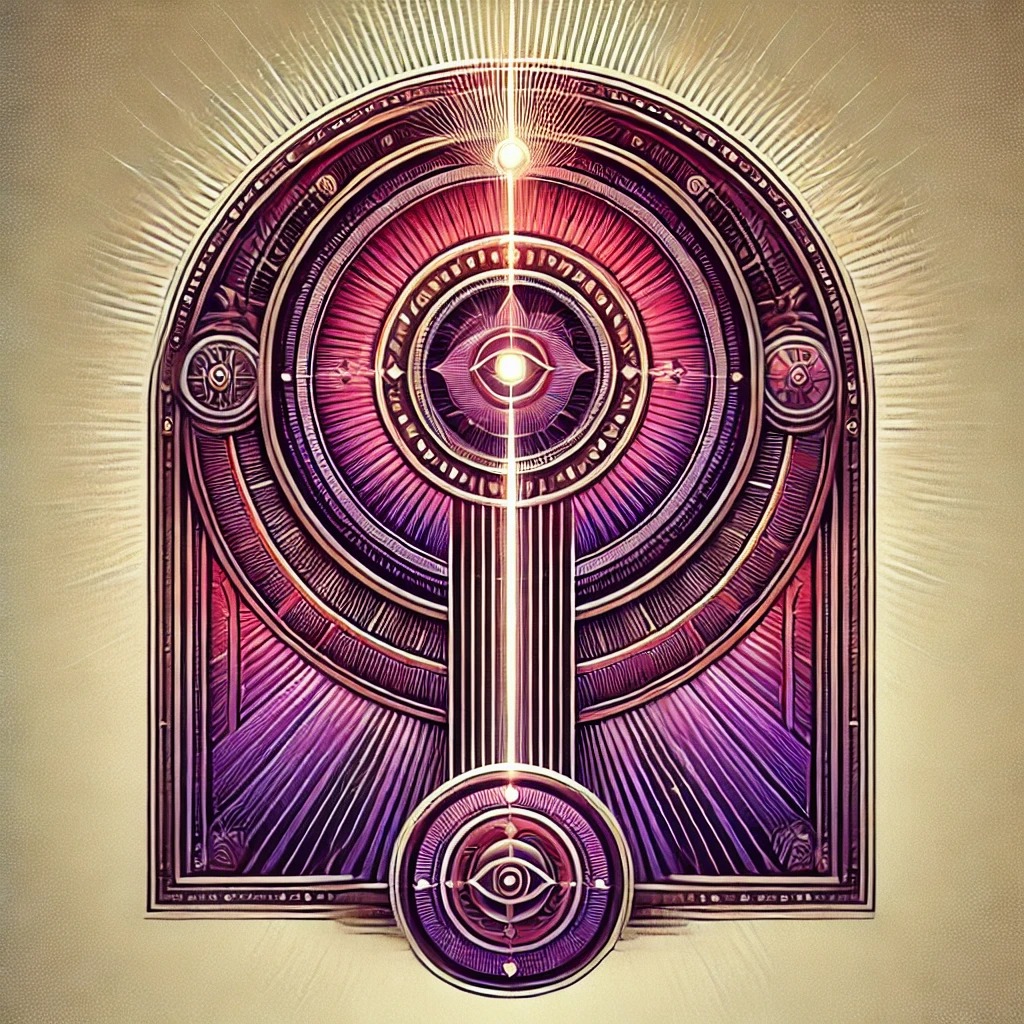
A short story — original fiction from Arquivo Cósmico.
I found the medallion among the belongings of Professor Ezequiel Varga, three days after his disappearance.
It was kept in a box of dark wood, wrapped in purple cloth and accompanied by a single note:
“Never place it before a closed door.”
I knew Varga during my studies in archaeoastronomy. He was a reserved man, given to long silences and to theories the other professors filed away, indulgently, as senile eccentricities. For years he had investigated pre-human cults mentioned in fragmentary inscriptions from Mesopotamia, the Iranian plateau, and certain cyclopean ruins found beneath the sands of Mauritania.
In all of them the same symbol appeared: an eye enclosed by concentric circles, crossed by a vertical line.
The ancients called it Namar-Keth.
According to Varga, the name might be translated as “the one who watches through the interval,” though the few surviving texts contradicted one another. Some described Namar-Keth as a god. Others, as a machine. And there was a third interpretation, far more disturbing: Namar-Keth would be merely an organ, a small part of something immeasurable, suspended beyond the limits of matter.
The medallion in the box reproduced that symbol with precision.
It was made of a reddish metal that resembled bronze, though it stayed cold even when heated. At its center lay a translucent stone, like amethyst, cut in the shape of an iris. Around it, minuscule mobile rings turned without any apparent mechanism.
I took it home that night.
For hours I examined the object under a lamp. I discovered microscopic inscriptions engraved along the edges, composed of signs that resembled, all at once, letters, planetary orbits, and anatomical diagrams. I copied a few of them into my notebook and, out of curiosity, tried to reproduce their arrangement.
When I finished, I realized the symbols formed a star map.
Or nearly so.
The stars depicted did not match the terrestrial sky. Some constellations seemed to hold impossible angles, and there were regions where the stars were arranged in perfect spirals, as if obeying the geometry of a mathematical intelligence.
At the center of the map lay an empty circle.
At midnight, the rings of the medallion began to move.
I heard no gears. There was only a low, continuous sound, like the murmur of many voices pronouncing the same syllable in unison. The central stone gave off a faint glow, casting a line of golden light upon the wall.
The line touched the study door.
I remembered then Varga’s note.
“Never place it before a closed door.”
I rose to remove the medallion, but the rings were already spinning faster. The light widened, tracing upon the wood a succession of luminous circles. The paint on the door seemed to dissolve. Then the wood, the hinges, and the wall around it lost their consistency.
Where the door had been, an opening appeared.
Beyond it was not the hallway of my house.
I saw a vastness without horizon, lit by violet suns. Circular structures floated in the void, so large that entire worlds could pass through them. Among those forms moved shadows whose size I could not calculate. They seemed to navigate space like sea creatures in a black ocean.
Then I understood that the circles were not portals.
They were pupils.
That entire landscape belonged to an eye.
The medallion trembled in my hand.
Something on the other side perceived my presence.
The violet stars went out one by one. The structures ceased their movement. The vastness concentrated upon me with the silent attention of an intelligence that had never known haste, for it would measure its existence in geological ages.
A voice was born inside my head.
It was not sound, but meaning.
OPEN.
I fell, dropping the medallion. The opening remained before me, pulsing like a membrane. From the center of that darkness rose a vertical line of light, identical to the symbol engraved on the object.
The light crossed the room.
For an instant, I saw my whole house as if its walls were transparent. I saw the foundations buried in the soil, the pipes, the electrical cables, the ancient tunnels beneath the city. Further down, far beyond the layers reached by any human excavation, I found circular forms asleep in the rock.
Thousands of them.
Closed eyes.
The revelation was so sudden that I lost consciousness.
I awoke at dawn. The door was in its place. The medallion lay on the floor, motionless and opaque.
In the days that followed, I tried to convince myself it had all been a hallucination brought on by exhaustion. I put the object back in the box and sealed it with wax. Then I locked it inside a cabinet.
The next night, I heard the murmur.
It came from within the walls.
On the third night, the circles began to appear. First in the mirrors, then in the windows, in dark screens and metallic surfaces. Always the same design: concentric rings surrounding a motionless eye.
On the fifth night, I received a letter.
There was no sender. Inside the envelope I found a photograph of Professor Varga, seated before an enormous circular structure. Behind him rose a stone door covered in inscriptions.
On the back, someone had written:
“He too believed he had closed it.”
Since then, I no longer sleep.
Today I noticed the symbol has appeared on the door of my bedroom. It was not drawn or engraved. It is simply there, as if it had always been part of the wood.
The rings began to turn a few minutes ago.
The golden line already touches the ceiling.
I write these words because I have finally understood the true meaning of the name Namar-Keth.
It is not “the one who watches through the interval.”
The correct translation is:
“The interval through which He watches.”
Enjoyed the cosmic dread of Namar-Keth? It drinks straight from the well of H.P. Lovecraft — the master of the horror of the unknown, of indifferent gods and truths the human mind was never meant to reach 👇