Shadow
A short story — original fiction from Arquivo Cósmico.
On the eleventh day crossing the Steppe of Sarn, when the escarpments of Khevar should already have bitten into half the horizon, I found the one thing no map recorded.
Had I understood what rose from that plain, I would have kept walking until the sun consumed me.
But I still believed the sun was the enemy.
As a child, I slept with a lamp lit. I feared the space beneath the stairs, the back of cabinets, the dark mouth of the cellar. I spent my whole life preferring the light. It took me forty years and a cursed steppe to learn that the dark had never been the threat — only the shelter I did not know I was losing.
The merchants of Taar do not cross Sarn in summer, and cannot say why. They speak of the heat, the uncertain wells, the trails that fade among the stones. None of them speaks of the light, because none of them came back to tell.
I left the post with provisions for eighteen days. On the third, a gale buried the markers. On the fifth, the compass began to tremble. On the seventh, the wind died, and the steppe fell silent in a way I had not known possible: no insects, no birds, no scratch of creatures beneath the stones. The canteen struck the buckle and the sound vanished before it returned, as if the air were too wide to give it back.
It was then that I noticed the ground.
It was washed. Not dry — washed, like a bone left decades in the sun, like a wall scrubbed of all its soot. The pale stones hurt the eyes; the dark ones shone like hot metal; the cracks displayed every grain at the bottom. There was no gloom anywhere. Not beneath the stones, not inside the withered plants. As if someone had passed through and scraped the shadow from the world, leaving only the glare.
And, above all, the sun.
Since the eighth day it had hung almost at the zenith, large, white, haloless — a disc nailed to an empty sky. I walked for hours and found it in the same place. I slept beneath the same brightness and woke beneath it. My eyelids gave no shelter: shut, they let through a pulsing red, and at times I saw through them the outline of my own fingers.
On the ninth day, I found a stone the height of my chest, with an overhang that should have given shade. I circled it once, twice. Every face was lit. I held my hand before it: my arm did not darken the surface. I brought my palm nearly to the touch. Nothing.
The stone cast no shadow.
Neither did my body.
I took the coat from my pack and spread it over my head. I could still see my hands. The thick cloth seemed steeped in light; the inside of the sleeves glowed. I opened the pack and found the canteen, the food, and the compass bathed in the same white. I shut it quickly, the way one closes a wound.
It was there that the word began to occupy me. Shadow. Not as an obsession, at first, but as longing for something I had always had for free. I remembered the awnings of Taar. The heavy curtains in my mother’s room. The space beneath the stairs I had feared all my life — and which now, in memory, seemed the sweetest place in the world.
On the tenth day, I knelt and dug. I opened a hole deep enough to bury my arm, certain the lower layers would keep some dark.
The bottom of the hole shone. The light welled up from within the earth.
I stared at it a long time. Then I screamed, and the scream crossed the steppe and did not return.
It was on the eleventh day that I saw the mark.
At first, a grey streak flickering far beyond the stones. I washed my face, blinked, pressed my eyelids until they burst into color. The mark remained. I changed course.
For hours it had no form: now a tower, now an enormous tree, thick-trunked and low-crowned. My body understood before my reason — my heart raced, my throat tightened, and I walked faster.
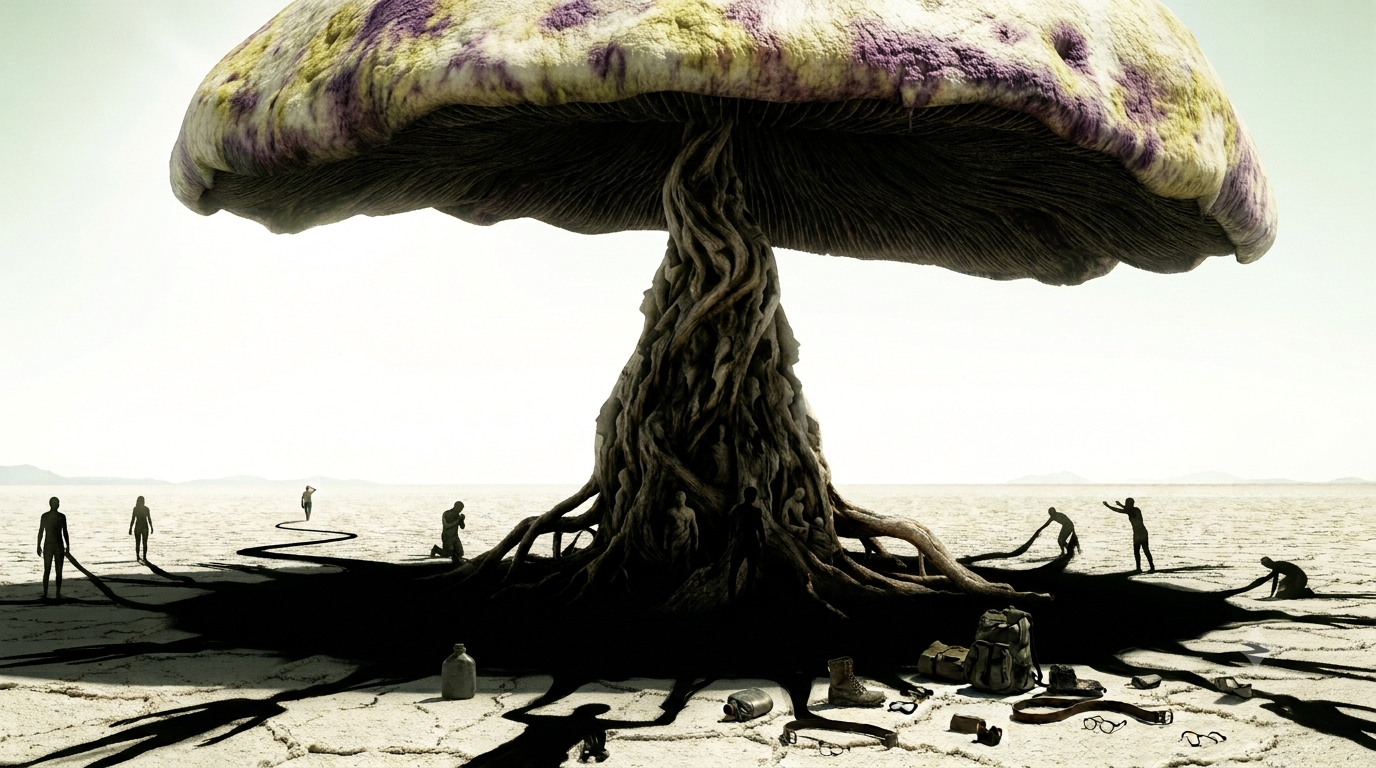
What I had taken for a trunk was a pale stalk, swollen at the base, run through with thick fibers, rising nearly thirty meters. At the top it held up a wide, flaccid mass: a cap of sick flesh, blotched yellow and violet, its edges hanging in heavy lobes, and beneath them thousands of thin gills. The stalk twisted like a bundle of compressed bodies. The fibers were exposed tendons. And the cap leaned slightly toward the side I came from, though the air was dead.
Beneath it, the ground was black.
The patch spread for dozens of meters in an almost perfect circle, with narrow extensions reaching across the steppe like roots. It did not obey the sun. And then I understood the washed ground, the world without gloom, the shadow scraped from everything: it had not been erased. It had been gathered. Leagues upon leagues of shadow harvested into a single place, heaped in that circle until it took on depth — a well laid flat upon the ground, deep enough to drown in standing up.
I stepped back.
A cold breeze touched my face — the first cold air in eleven days, smelling of damp earth, rotting leaves, and stored wood. I closed my eyes and breathed deep. When I opened them, I was already walking again.
The first object appeared a kilometer from the fungus: a dented canteen, still holding water. Then a buckle, a strip of leather, the broken frame of a pair of glasses. Then the stains on the ground — long, narrow, with two parallel extensions that looked like legs. One looked like a kneeling man. Another had five thin fingers. The light fell on them without dissolving them.
The coolness grew with every step, and my burned skin begged for it.
That was when I made out the figures on the stalk. They looked like people leaning against the fibrous surface — seated, standing, arms hanging. I called. No one answered. Up close, they lost volume: dark silhouettes stuck to the stalk, bodies reduced to outlines, overlapping like old stains of damp. Some faces could still be recognized. Closed eyes. Half-open mouths. The expressions resembled relief.
The gills quivered above them in a slow undulation, and a fine dust broke loose and vanished before touching the ground.
To retreat seemed, for an instant, the only way out.
Then something held my foot.
I looked down. A dark form was born from my heels and stretched toward the fungus. It was the outline of my body — the first shadow I had cast in eleven days. The sun was still at the zenith, and did not justify it. It was not mine: it was a hook, and I the line.
I took a step back. The shadow stayed fixed to the ground before me, stretching like a membrane about to tear, and I felt the pull at my ankles. I tried to veer left; it followed with a delay, dragging over the earth, shortening when I advanced.
And the coolness was already climbing my legs. The burning faded. The pain behind my eyes eased. A delicious torpor softened my muscles, and the dark edge was a few meters off, littered with packs, belts, shoes dropped in haste.
When I crossed it, the light ceased.
I fell to my knees. I closed my eyes and, for the first time in days, there was darkness behind my lids — the same darkness of the space beneath the stairs, the one I had feared all my life, and which now took me in as never before. The air was cold. The ground, soft and damp. A deep, rhythmic sound passed through the gills.
I breathed. And the sound breathed with me.
I dragged myself to the stalk and leaned my back against it. The surface gave, warm and elastic. Only a few minutes, I thought.
The stillness began in my feet. I blamed exhaustion, and let the torpor rise to my knees. The murmur around me grew clear — and they were breaths. Many.
I opened my eyes. The figures covered the whole stalk, some almost touching my shoulders: to my right the profile of a woman; to my left, a man with his mouth open in a soundless scream; above, a small form clinging to the silhouette of an adult.
I tried to rise. My body did not respond. My boots were still there, but their outlines blurred into the ground, and the dark climbed the leather. I ordered my fingers to move: the hand resting on the ground was flattened and dull, the joints already without relief. I managed to drag the arm a few centimeters — and part of it stayed on the stalk, without pain, with the meek resistance of a wet leaf one tries to peel from a wall.
I forced my neck and looked behind me. There was a new silhouette on the pale surface: the shoulders, the curve of the head, the arm on the ground. The face still incomplete.
It was mine.
On the burning horizon, a small form moved. A man, walking slowly, a hand over his eyes. He stopped when he sighted the fungus, and even at that distance I saw the change in his body: he had found what he was looking for. He began to approach.
I fought to raise my arm, to strike the stalk, to make any sound. My mouth stayed open on the surface, mute. The silhouette at my back moved only enough for its fingers to lengthen across the steppe, toward him.
And then I understood why he would not be able to stop.
The shadow that pulled him was already, in part, mine.
Loved this horror of a motionless sun and impossible ecology? It converses with two classics of the weird — the nature that returns its expeditions as shadows, and the light that came from space to corrupt 👇